
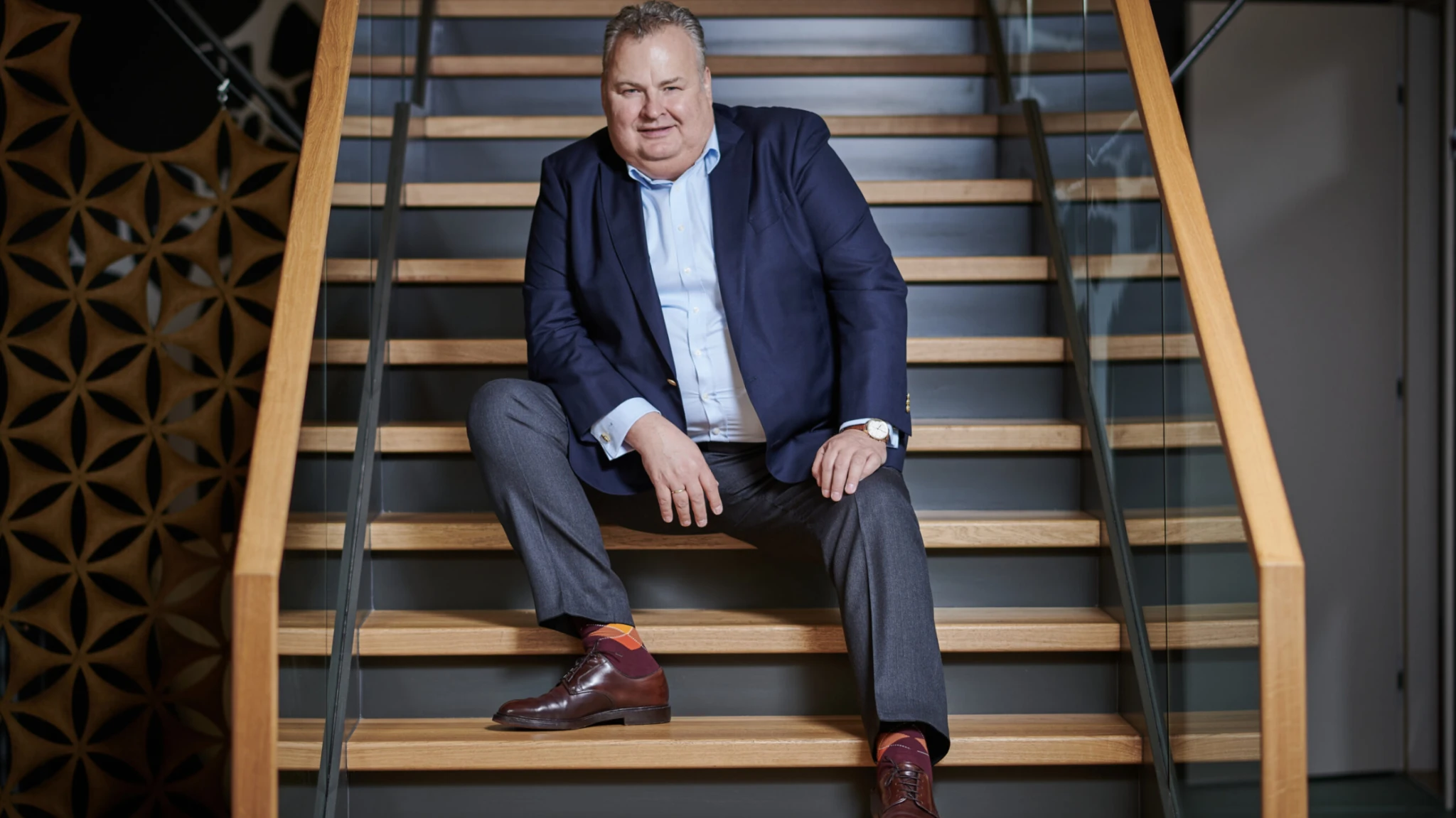

[This is an English translation of an interview originally published in Czech.]
“I always wanted to work on truly major deals,” says Jan Chalupa, Managing Partner of Tarpan Group. He was involved in major transactions from the beginning of his career, first as a manager at Česká spořitelna and later in his final corporate role at the investment group PPF. He then broke away from the corporate world and founded a private consulting firm. In this interview, he discusses the key moments in its fifteen-year history, its strategy for the future and the personal and team values behind Tarpan Group’s success.
Astra Palace on Wenceslas Square is one of the most attractive locations in central Prague. On the third floor, you enter the offices of the consulting firm Tarpan Group not through the reception area you might expect, but directly into the living room, as Jan Chalupa, the group’s co-founder and Managing Partner, calls the space immediately inside the entrance. “When you come here, it is simply like coming into someone’s home. It is part of our philosophy,” he says with a smile. What does he mean by that?
“Definitely more personal relationships with clients,” he says, emphasising the defining characteristic of the entire Tarpan Group. He could talk for hours about exceptional client relationships, mutual trust and loyalty. He lives by these values, and it shows. Chalupa specialises in private equity and venture capital.
He has held management positions at a number of financial institutions. He began his career at Česká spořitelna as part of the team that built its capital markets operations. At the investment company investAGe, he managed the portfolios of some of the first non-privatisation funds in the Czech Republic. He served as a division director at IPB, where he was responsible for investment banking and capital markets trading.
He was an executive director at Credit Suisse Life & Pensions Czech Republic, an insurance company and pension fund. He co-founded the international companies PPF Investments and PPF Partners. He managed transactions from both Prague and London, where he lived for several years. Eventually, in 2009, he decided to venture into business on his own and came up with the idea of establishing Tarpan Partners, the first of the Tarpan Group companies.
Today, the group advises major market players and divides its services into several areas – M&A and financing, corporate crisis resolution, legal advisory, real estate and interim management. It also actively supports start-ups.
Over the fifteen years since its establishment, it has put down strong roots in Czech business, as demonstrated by its list of successfully completed transactions and advisory mandates. One of its first truly significant mandates involved addressing the collapse of ECM, one of the leading property developers in the Czech Republic and Slovakia.
Tarpan Group experts also acted as economic advisers to insolvency administrators in addressing the insolvencies of the mining company OKD, subsidiaries of the Vítkovice holding company, Czech Airlines and Pilsen Steel, one of the oldest and largest metallurgical plants in Europe. There, they provided economic and legal advice while also organising the realisation of the insolvency estate and the sale of the business to a strategic investor.
As advisers, they supported Jan Řežáb and his company Socialbakers, for example, in its international expansion.
They were also behind the sale of Mailstep, one of the largest Czech logistics companies in the e-commerce sector, to Jiří Šmejc’s Emma Capital group, and the sale of a majority stake in international audiovisual leader AV Media to the Czech private equity group Genesis Capital.
“That was a truly wonderful transaction. I had not seen such satisfied sellers and buyers for a long time,” Jan Chalupa says approvingly.
Several years ago, the group expanded its portfolio of advisory services to include real estate. Its most visible project in this area to date has been the sale of Bellevue Palace from the portfolio of the collapsed Arca group. The building in central Prague was purchased a year ago by EP Real Estate, part of Daniel Křetínský’s holding company. It took Tarpan approximately seven months to negotiate the entire transaction.
Chalupa also recalls the rescue of Vagónka Studénka and the seemingly inconspicuous story of UniControls, a company specialising in control and management systems for industry and rail transport, which Tarpan also managed to save.
“I personally managed the company for about two years. We successfully sold it and returned assets to creditors amounting to nearly one hundred per cent of their claims,” he explains. “That gives you a wonderful feeling. We do not advise companies in crisis situations in order to liquidate them. We always try to save them, provided there is at least some reason to do so,” emphasises the fifty-six-year-old partner at Tarpan Group.
When the economic crisis was gaining momentum in 2009, you left a management position at a large investment group and ventured into private business. What led to your decision to establish Tarpan?
I was struck by a midlife crisis, and I did not like it. I had a brilliant career, had spent years climbing the corporate ladder, earned good money and believed that the higher I rose, the freer I would become. But when I turned forty, I realised that it was all wrong.
Why?
Because you gradually lose that freedom instead. What frustrated me most was being trapped by decisions that were not mine. I realised that I wanted to make decisions for myself. I also saw many people around me who had completely prioritised work over their personal lives and were not entirely happy as a result. They had genuinely sacrificed almost everything, and I did not want that.
Was it the best decision of your life?
Yes, it was the best business decision of my life. I wanted to be independent, and I achieved that. At the time, I was leaving PPF, which had been the most amazing job of my life, an incredible experience and a truly extraordinary ride. It allowed me to travel all over the world and work on international transactions. With the PPF brand behind us, we worked with the very best people and advisers, which was genuinely excellent. On the other hand, I suddenly had to use the savings I had accumulated during my corporate career to finance the company’s launch. You keep checking your bank account and waiting for the moment when things finally turn around. That was probably the most nerve-racking part.
What helped you when starting your own business?
I had always surrounded myself with people whom I knew I could approach when I decided to build something of my own. They are the current partners of Tarpan Group: Michal Kuděj, Luděk Skoupil and Tomáš Kozubek, whom Jan Bubeník introduced me to at the time. Daniel Hříbal and Tomáš Petržela joined them last year.
What took you by surprise?
At the beginning, an incredible amount of energy was required. We thought that, with our experience, we would arrive and immediately begin working on interesting mandates, but that was not the case. Like probably everyone in that situation, we started from absolute zero. I had undoubtedly irritated quite a few people in business before then, so afterwards they made me pay for it a little.
From left: Jan Chalupa, Daniel Hříbal, Tomáš Petržela.
We told our business partners that they already knew us, but they responded that our company did not yet have any references. At the beginning, Michal Kuděj and I told each other that we were destined to succeed because we had no other option. You cannot fail; you simply cannot. And when you want something, you will achieve it, but you have to truly want it!
When did you first feel able to breathe more easily?
Probably after the first six years. That was when we decided to expand the team and the range of services. Then again four years later, when we already knew that we had what is known as “proof of concept”. We knew that we were capable of handling not only small transactions, but genuinely large ones as well, mandates of different types and risk levels, that we had excellent results and, crucially, the references we needed so much. At that point, things had become established. We began making money after our third year in business, but it was very close.
I also see the past eighteen months as a major step forward. We increased the number of partners from four to six. It may sound like a simple administrative exercise, but it is a lengthy and difficult process involving, among other things, changes in communication and decision-making. Nevertheless, I see it unequivocally as a step in the right direction. Dan Hříbal and Tomáš Petržela are making a significant contribution to the development of our companies and our team. The second crucial step during that period was the previously mentioned expansion of our expertise into real estate.
Do you associate that shift with any particular transaction?
Not just one. Competing alongside the Big Four and major law firms, we succeeded in winning mandates for OKD, Vítkovice and transactions involving substantial revenues. That certainly played a role. We started during the 2009/2010 crisis with distress management and corporate crisis situations, but we urgently needed a second pillar for the business to spread the risk. Transaction advisory, comprising M&A and financing, became that second pillar. We succeeded there as well and were soon working on major transactions for interesting and experienced market players. But for me, the COVID pandemic was the litmus test of our group’s resilience.
In what respect?
It confirmed that we were sufficiently flexible. We were very well prepared technologically and came through this difficult period quite successfully. On the other hand, we confirmed that creative remote work and video calls do not work optimally. We therefore subsequently tried to create an environment to which everyone would want to return. We succeeded.
From left: Petr Bukáček, Ladislav Šelepa, Tomáš Veselý, Lukáš Bachtík, Jan Chalupa.
We moved into new offices, and within two years after COVID, Tarpan Group began to pulse with an entirely new life. That was when I felt that everything was going well. Clients began visiting us informally, sometimes stopping by simply for a coffee or a drink. We began to serve as a kind of base for them in the city centre.
What creates this internal atmosphere?
We are probably the only company in the Czech consulting sector that is not “single-owned”. We have a reasonably sized partnership that we are prepared to continue expanding. This is more common among law firms, but not really in our field. We do not pretend to be managers; everyone has their own expertise, and we all work on assignments. At the same time, we surround ourselves with younger colleagues and pass our experience on to them.
How large is the Tarpan Group team today?
The team consists of slightly more than twenty people, and it looks as though we will double it in the near future. We do not want to grow much more than that, however, because the daily interaction that we need and value then ceases to function.
What role has personal chemistry played, and what role does it continue to play, in building the team?
A fundamental one. Friendship and respect are always built on a foundation of professionalism. When you know that someone is genuinely good and want to work with them over the long term, you appreciate it when a certain chemistry develops. I am talking about people who are exceptionally accomplished and intelligent professionals, but who also possess self-awareness and a healthy degree of humility. They have an inner drive that propels them forward. They do not need to advertise how good they are, because they simply are.
Can credibility and client relationships be built on that in a sector such as economic and legal advisory?
We simply decided to do things a little differently. Promise clients the earth simply to make money? Even when we see no potential? We would rather not undertake such transactions. Clients have the right to hear what their situation really is, and we help them make the right decision. It may take longer, but there is then a high probability that they will succeed and make more money as well. We are also prepared to assume part of the risk ourselves, which clients appreciate.
Do you ever turn down an assignment?
Yes. But not from a client with whom we have already built a relationship. We cannot say no to such a client. But that kind of client knows us and knows how to listen. Some clients first need time to absorb our approach, and sometimes that can take longer.
Can you give an example of your approach?
You have spent thirty years building a successful company and now want to sell it. You are doing this for the first time in your life. Yet selling a company well is an art and genuinely delicate work. It is good when clients understand that they will receive the most money when prospective buyers compete for their company to some extent. You therefore need to create a competitive environment in which several prospective buyers want the company and compete with one another. Healthy competition is good, but at the same time, you must be fair. You represent your client, but you also work with many major market players, and you cannot alienate them. Everyone must have a guarantee that we are conducting an entirely transparent and fair process. So far, we have always managed to achieve that, and it has worked for all parties.
What other strategies do you use to compete with your rivals?
We are genuinely independent and flexible. We are not part of multinational corporations or trapped by complex bureaucratic processes. We are highly opportunistic and have no difficulty remaining open to new ideas and connections. Another essential value is the previously mentioned relationship with our clients. The hardest part is always persuading clients to work with us, but once they have experienced working with us and understand how we approach solutions, they usually stay with us.
Real estate was added to your portfolio relatively recently. Why did you decide to expand in this direction?
We help you sell a large company successfully, you become wealthy, and the first thing that usually occurs to you is to buy an impressive property. Moreover, real estate forms part of most of the mandates we handle. When we address a corporate crisis, there are usually loans secured against property. Or properties that you do not use and can dispose of. You also consider separating real estate assets in M&A transactions. We kept putting these pieces together until we understood that we could not do without real estate and that we had to offer it as a specialised service.
What, then, does Tarpan encompass today?
It comprises people, companies and capabilities. There are three companies under the Tarpan Group umbrella. We have Tarpan Partners, a company providing economic and financial advisory services. Tarpan Legal is a law firm providing legal services across a number of areas, not only in cooperation with the group’s other companies, but also offering standalone legal services to its own domestic and international clients. Tarpan Managers specialises in interim management – managing companies and projects from establishment through growth and problem-solving to the potential sale of the companies.
What is your vision for the future of Tarpan Group?
We want the group to continue prospering and eventually to hand it over successfully to our younger colleagues. Within ten to fifteen years, which is a foreseeable period, our business will need to be taken over by someone from among the people we are already preparing for that responsibility today. I would like us one day to hand them something that is sound and strong and has a good reputation in the market. We want to strengthen what we do today while also seeking further opportunities that will allow us to offer clients a broader range of services and greater value. There are genuinely many opportunities and ideas.

11. 6. 2024