
[This is an English translation of an interview originally published in Czech.]
They have also frequently assisted, and continue to assist, with their financing. Their success, however, began with a significant risk: Jan Chalupa and Luděk Skoupil left management positions in which they had both worked for Petr Kellner. As the crisis was beginning, they joined Michal Kuděj and Tomáš Kozubek in building the Tarpan consulting brand, which brings together economic and transaction advisers, venture capital experts and lawyers.
21 May 2025
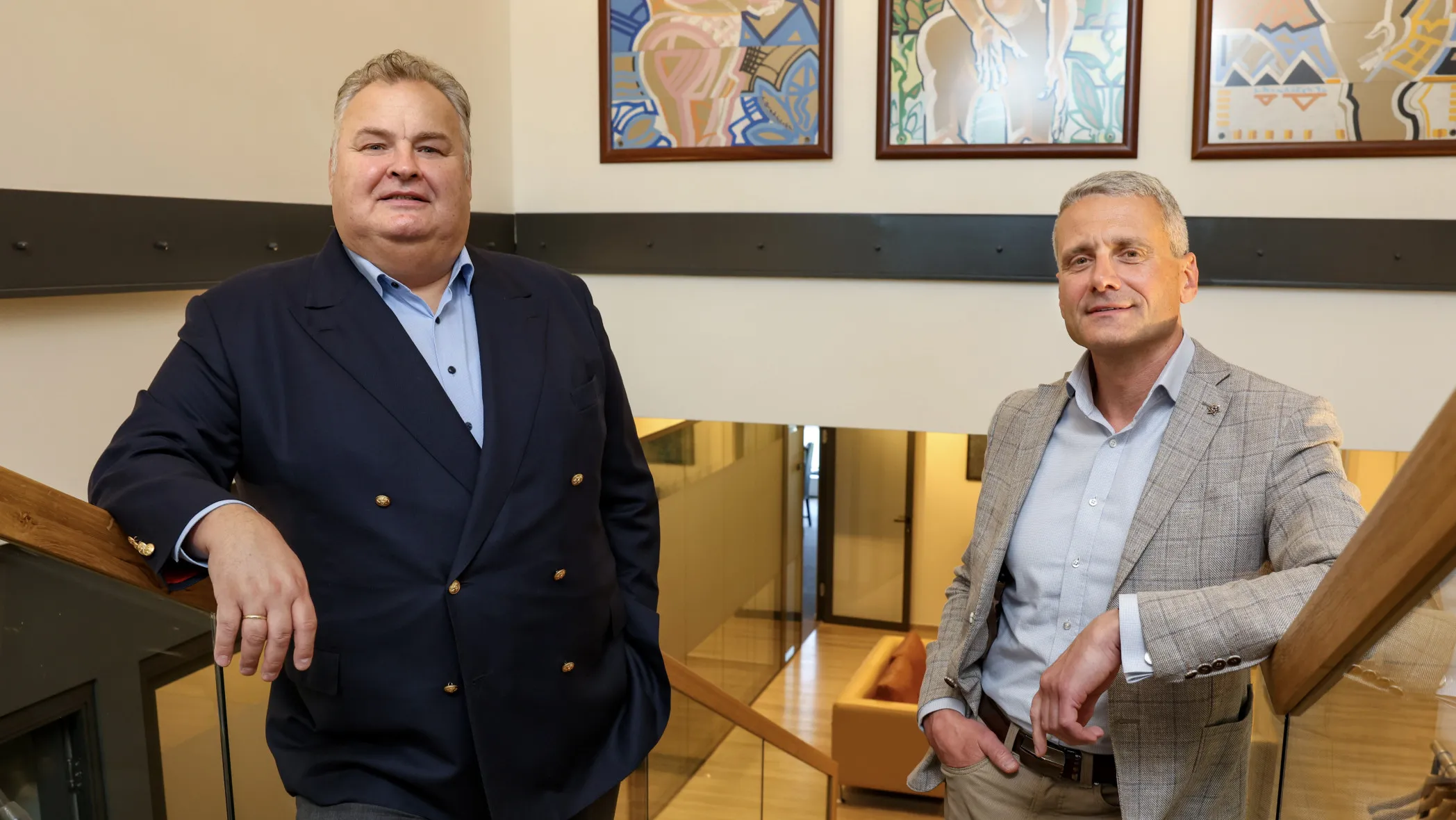
Photo: Tomáš Novák / Hrot24
Their experience, as well as their own business story, may be inspiring today – at a time when, according to many voices in politics and business, we are facing unprecedented change.
“Every difficult situation is also an opportunity. New sectors, new activities and new partnerships around the world can benefit from it. It is important not to panic, to have courage and to seize the opportunity,” economist Jan Chalupa and lawyer Luděk Skoupil agree in an interview with Hrot24, in which they also reveal how Petr Kellner inspired them.
People often say that we are living through an unprecedented situation. But you began building Tarpan Group during the most recent major financial crisis. Are we viewing the present with too much fear?
Jan Chalupa: I was working in England at the time and came to understand how such crises usually unfold. Put simply, the poor remain poor and the rich suddenly become somewhat less rich: they lose a few billion, but they are still fine.
Those who suffer the most are the middle class, who are usually in debt and paying large mortgages, consumer loans and for their children’s education.
It is true that when Luděk and I began discussing the idea of establishing a company sometime in 2008, everyone looked at us as though we were mad. They considered it absurd to build a company during a crisis.
But we told ourselves that there would always be some obstacle or excuse, and that we needed to become opportunists and make use of the situation. We would save our clients’ businesses.
What was happening at the time therefore worked more to our advantage. The key to starting the business was to begin earning money and building the company as quickly as possible, nothing more.
The situation today is completely different. The world has become somewhat more complicated. We are not yet in an economic crisis, but we are experiencing a political one. The “political” world order to which we have been accustomed since the Second World War is changing.
Mistakes can be seen on all sides, but the fundamental factor is the Trump effect. He behaves quite unpredictably, and partly because of him the world may be returning more rapidly to an expansionist form of politics in which the stronger seek to take from the weaker.
Luděk Skoupil: These are interconnected vessels; the social climate and the economy are directly related. The economy does not benefit from the uncertainty we are now experiencing to a heightened degree. This is not only because of the United States, but also, for example, because of China’s growing assertiveness.
Globalisation – as we knew it over recent decades – has ended. But it is always necessary to take a step back and look at matters from a broader perspective. In five or ten years, perhaps today’s problems will appear trivial to us. It is difficult to predict what will happen.
I do not see it as entirely bleak, however. As Honza has already suggested, every difficult situation is also an opportunity. New sectors, new activities and new partnerships around the world can benefit from it. It is important not to panic, to have courage and to seize the opportunity.
I think this is also reflected in the major mandates you have worked on. Crises and uncertainty create opportunities for the courageous, and when someone tries an unconventional approach, it may prove profitable. Has this always been true, and is it likely to remain so?
Jan Chalupa: This is as true as the principle that every cause has an effect. I was part of one of the final cohorts to enter university under the previous regime. Then we had a revolution, everything effectively began again and it became the greatest opportunity of our lives.
Luděk and I have effectively experienced everything that exists in the economy: from privatisation, the establishment of the capital market and price liberalisation to prohibition and lockdown during the pandemic, as well as the continual introduction and abolition of various regulations. New sectors emerged and others disappeared.
We now live in a world in which we must be extremely flexible. Obstacles can be found in every situation, but so can interesting commercial opportunities.
The Czech lands, whatever we choose to call them, have in many cases managed to seize opportunities over the past 30 years and make perfect use of them. But they have squandered just as many. To summarise, the world essentially continues to behave in the same way; it merely presents itself differently.
You have experienced situations in which enormous companies, such as Czech Airlines or Vítkovice, were heading for collapse, but you helped save them. Can every company be rescued if the process begins early enough and is handled properly?
Luděk Skoupil: The question is what “early enough” and “properly” mean. Sometimes a rescue genuinely is no longer possible. That makes us all the more pleased about other situations that we have had the opportunity to encounter in the course of our work.
These were companies with potential and good products. They had simply experienced an extraordinary event that caused an upheaval. We were able to help stabilise the situation and put everything back on track.
This is important not only from a business perspective; it also energises me emotionally. I think it is normal to like stories with happy endings.
As the environment changes, however, the structure of business changes as well. Consider, for example, the situation of our last steelworks. I recently listened to an interview with its CEO. Because of the current climate and regulation by the European Union, some of its activities are beginning to encounter not financial limitations, but technical and physical ones.
Třinecké železárny has annual revenues of approximately CZK 30 billion, yet it generates a profit of only CZK 40 million. That is alarming. The company is so large that it operates its own power plant. If even the slightest problem occurs in its operations, the production programme ceases to make sense.
The CEO, who is evidently the right man for the job, concluded the interview by asking whether we know where – if the steelworks ceased to exist – we would obtain steel for railway tracks, for example. Or, as is now being discussed openly, for manufacturing weapons.
Jan Chalupa: The viability of such operations depends on the foundations on which you are doing business: whether you have the necessary raw materials and whether you can find young people willing to do the work you require.
We no longer live in the 19th century or in the era of Comecon, when someone decided that iron would be produced here and electronics in the German Democratic Republic.
It does not make much sense to save some areas. But they can be converted: you might begin producing specialised castings and sophisticated products, for example. Traditional metallurgy as we know it from history, however, probably no longer has a place in the Czech Republic.
Our experience also shows that even highly modern companies with modern products disappear. This happens because of their owners. A generational transfer may fail, or the owners may become tired and begin arguing among themselves. And if nobody reminds them where this may lead, the company will come to an end.
But it genuinely makes sense to help such companies – ideally in good time, or at least during insolvency proceedings, when it may be possible to find new owners who will continue the business. We have succeeded in doing this several times. If you try hard enough, you will usually find a good solution.
Should some companies therefore be allowed to disappear?
Jan Chalupa: We should also remember that the relocation of traditional industries elsewhere, perhaps to Asia, tends to be irreversible – although perhaps not entirely. Clothing is now being manufactured in Spain and Portugal again, for example. Many companies discovered that large-scale manufacturing in China, measured in container loads, means writing off an entire collection if it fails.
We should address these issues at the level of the European Union. If we are discussing steel production, even if it may not make sense in the Czech Republic, the sector must certainly not disappear from Europe because of an energy policy favouring “better” sources.
The same applies to the extraction of raw materials and many engineering sectors, as well as semiconductor manufacturing. There are simply industries, both traditional and new, that you need to have within reach under all circumstances.
Unprecedented situations await us, and we must be prepared for them. The Czech Republic will never be entirely self-sufficient, but that does not apply to the European Union. A somewhat different game is being played here, and any form of dependence is usually dangerous.
Luděk Skoupil: Society has reached extremes many times throughout history. I call it social kinetics, because every swing is followed by a counter-movement. That counter-movement may not be pleasant, but the result is always the eventual achievement of a certain equilibrium.
Whatever negative event occurs also has a positive effect by stimulating society. It may be unpleasant, like when someone gains a few kilograms over Christmas and then forces themselves to go to the gym. They feel unwell at first, but then begin to feel better.
From a certain medium-term perspective, this also applies to Europe. It will begin thinking again in ways that return it to where it belongs. Based on historical experience, it should play a significant role globally. Over the past twenty years, however, it has rested on its laurels and stagnated. I do not believe the damage is irreversible. Something can be done about it.
Turning to the managers we have already mentioned, how do Czech managers compare with their international counterparts?
Jan Chalupa: There is no longer any difference in terms of knowledge and capabilities. Connections from universities and where people studied are important, but that applies globally.
Luděk Skoupil: I agree.
Jan Chalupa: There are capable people living in this country. It is remarkable, but even after those terrible years of communism, we remembered our entrepreneurial foundations. We returned to being a country built on small and medium-sized enterprises; it remained within us.
In many respects, we have even overtaken Europe, whether in the adoption of mobile phones or internet banking. Digital literacy is exceptionally high here. While people in the West were accustomed to many things, everything was new to us and we wanted to enjoy it all.
For a Czech company operating in the Czech Republic, hiring a Czech manager is therefore certainly the most effective option today.
Has the behaviour of Czech entrepreneurs and investors changed compared with the past?
Jan Chalupa: Compared with other countries, the Czech Republic has a genuinely large number of wealthy people relative to its population. Over roughly the past ten, perhaps even twenty years, these people have realised that the Czech Republic is too small for them and that they need to invest abroad. Consider Daniel Křetínský or Petr Kellner, for whom we worked.
What was Petr Kellner like?
Jan Chalupa: His story is more than comparable to Baťa’s. He operated all over the world thanks to his intelligence and capabilities, as well as those of his group. That is how he travelled so far and created what he created. And today he has successors.
Daniel Křetínský, for example, owns the British postal service, German steelworks, a French newspaper and numerous other acquisitions around the world. This is how Czech entrepreneurs have changed since the 1990s. At that time, they invested within the framework of privatisation and within the Czech Republic. Once the situation stabilised, they began looking abroad. That is the fundamental difference.
Advisers such as you must respond to this. Today, you accompany Czech investors abroad and must advise them effectively as they do so. What do you need for that?
Jan Chalupa: Experience. You need to communicate with the entire world and know what you need and expect from local experts. You should not demand more than necessary from foreign lawyers in Western Europe, for example, because they are extremely expensive. If you are paying a lawyer £1,200 an hour in the United Kingdom, you think very carefully about what you want to ask.
International experience is crucial, as is a certain degree of self-confidence. You must view the world from a broad perspective and recognise that there are no linguistic, social or educational barriers. A company on the other side of the world is usually similar to yours and faces similar challenges and difficulties.
When communicating, however, you must naturally pay attention to the words you use and to the jokes with which you attempt to lighten the situation, and you must understand the local culture.
Does this also apply to Czech lawyers working in international business? Must they understand the business, while resolving the technical details and legal differences with local lawyers?
Luděk Skoupil: Undoubtedly. Legal regulation may differ locally, but business is the same everywhere. We have handled numerous cross-border transactions in which we either negotiated with foreign investors or sold Czech assets abroad. The fundamental principles governing how a transaction proceeds and how a deal is concluded genuinely are the same everywhere.
The crucial factors are therefore the ability to understand the essence of the business and experience of how such matters are handled. In any event, we are already encountering situations in which advisers from Western Europe appear on the other side but are far less experienced and have difficulty negotiating with us effectively.
This is another respect in which the Czech Republic has advanced. Paradoxically, this is not necessarily an advantage. When the adviser on the other side cannot guide their client efficiently through the transaction towards the ideal outcome, far more effort is required to ensure that it ends well for everyone.
I understand that, owing to your duty of confidentiality, you cannot tell me about your current mandates. But, in general terms, what are you currently working on?
Jan Chalupa: We are not currently focusing as much on insolvencies because the economy has stabilised. Instead, we are working more on transactions, mergers and acquisitions. Everything is moving; there remains an appetite both to buy and to sell companies, and we believe this will continue for some time.
We also advise clients on the allocation of their assets, as many people are now considering how to diversify their investments around the world in view of global risk.
Investors want to be prepared so that they can respond flexibly. We manage business risks, because selling a company in an uncertain environment is more complicated.
And how will you, as Tarpan Group, approach current developments?
Luděk Skoupil: We respond to new regulatory situations and complement our portfolio with the services that are needed.
Jan Chalupa: Tarpan is continually evolving. We are expanding both our team and the number of products we offer. But we are not changing anything about our fundamental approach. We focus, and will continue to focus, on a smaller number of interesting transactions so that we can devote proper attention to them.
And we work only for clients whose plans we believe in and whom we are convinced can succeed. That trust must, of course, be mutual, and I believe our professionalism and results only serve to reinforce it.
Jan Chalupa
- Co-founder and Managing Partner of the Tarpan Group consulting group
- Held senior management positions at PPF Group and Credit Suisse Life & Pensions Czech Republic
- Served as Executive Director of Investiční a Poštovní banka around the turn of the millennium
- Graduated from the Prague University of Economics and Business
Luděk Skoupil
- Managing Partner of the Tarpan Legal law firm
- Partner at Tarpan Group
- Held various positions at PPF Group, most recently serving as Executive Director of PPF Partners
- Was responsible for the legal and compliance department at Credit Suisse Life & Pensions Czech Republic
- Graduated from the Faculty of Law at Masaryk University

21. 5. 2025