

[This is an English translation of an interview originally published in Czech.]
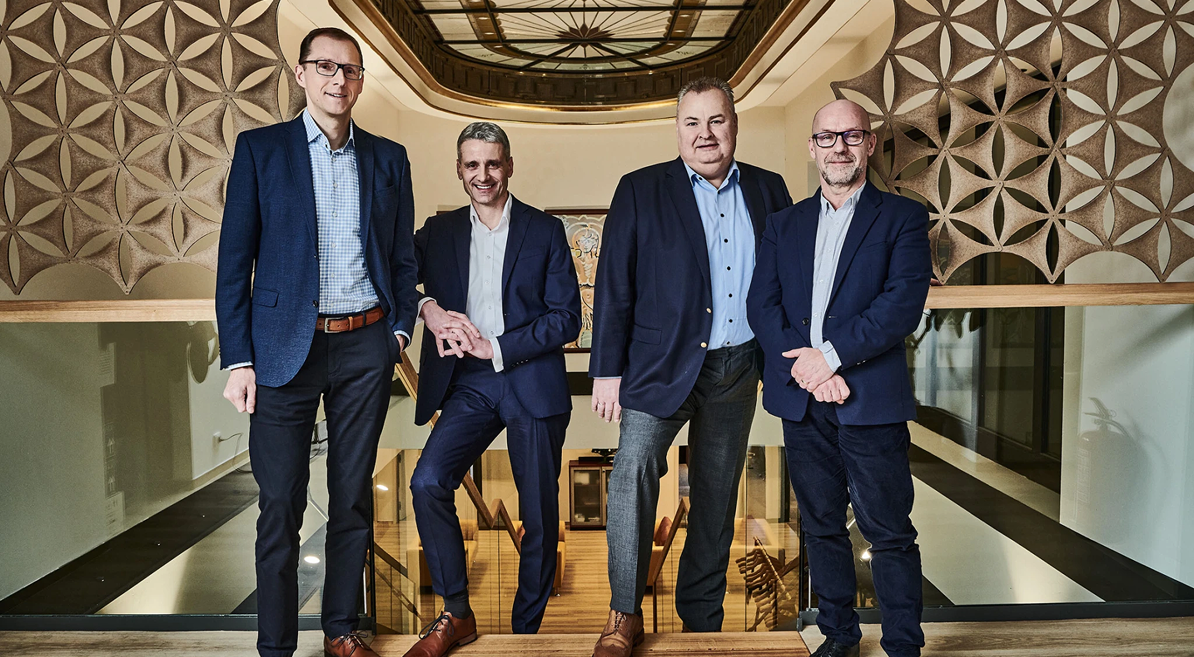
When they founded a consulting firm during the economic crisis in 2009, many thought they were crazy and gave the four managers a year, two at most. Today, Jan Chalupa, together with Michal Kuděj, Tomáš Kozubek and Luděk Skoupil, are partners at TARPAN Partners and play a role in major cases involving insolvency, turnaround and corporate restructuring. They support start-ups and help mature companies with long-term strategy, growth, international expansion and sales.
All for one and one for all. That is one of the reasons why Chalupa and his “three musketeers”, despite their different personalities, have weathered everything and succeeded in business. And after almost thirteen years, they have also remained friends. Their story may offer inspiration amid the current economic crisis as well. It is founded on common sense, trust and priorities that have shifted somewhat for the four men over the past decade.
Starting out in 2009 took courage. What led to the creation of TARPAN?
Chalupa: After years of climbing the corporate ladder, believing that the higher I rose, the freer I would become, I experienced a midlife crisis as I approached forty. The solution was either to take a year off, change companies and start again elsewhere as a senior manager, or to establish my own business. I chose the business and began putting together a team.
How did your team come together in the first place, and what motivated you to embark on a joint venture?
Kuděj: Honza approached me first. We knew each other. He knew that I had been working as an independent consultant since the 1990s. Unlike the others, I was not taking such a big risk – I was moving from one uncertainty to another. The decision was probably much more difficult for Tomáš and Luděk.
Kozubek: That is true. At the time, I had my dream job at McKinsey, and people simply did not leave a position like that back then. But I was flying around the world five days a week, which was incompatible with family life. I had a clear priority – to spend more time at home and in the Czech Republic. I knew neither Honza nor Michal; a headhunter brought us together through a “happy coincidence”.
Skoupil: I knew Honza from Credit Suisse. We had also worked together for Petr Kellner, and it had always worked well. Personally, I would have preferred to wait for the ongoing economic crisis to pass. But the inner urge to “experience real life” without the backing of a large corporation, and to try to succeed on my own without business cards bearing the name of a large company, was stronger.
From management positions and life as a freelance consultant to running a business. Did everything go smoothly, or did anything take you unpleasantly by surprise?
Skoupil: I had no experience of running a business, but I did have quite a few somewhat naïve ideas. The first lesson was that my existing network of contacts stopped working. In retrospect, the reason is obvious: those people were not interested in me, but in the corporation I had previously worked for. That was a major wake-up call, but also the driving force behind a new beginning.
Chalupa: When you hold any key position, many people come knocking on your door wanting to do business with you. But when you start your own business, some of them behave in precisely the opposite way. You could say they made us pay for it a little: “Until now, we were the ones knocking on your door; now it is your turn to knock on ours.”
Kozubek: We all thought it would be quick and easy because each of us had been successful individually. But suddenly, we were a new company with absolutely nothing behind us. We had to build our reputation, references and trust from scratch.
When did things begin to turn around?
Kuděj: Higher-profile cases covered by the media helped. One of the first major cases involved addressing the collapse of ECM, one of the largest property developers in the Czech Republic and Slovakia. In the insolvency proceedings, we represented the largest creditors, comprising a group of major international banks.
Chalupa: More cases gradually followed. As economic advisers to insolvency administrators, we worked on the insolvencies of the energy company Vítkovice Power Engineering, the mining company OKD, Czech Airlines, clothing manufacturer Blažek and Pilsen Steel, one of the oldest and largest metallurgical plants in Europe, where we provided economic and legal advice as well as support in finding the optimal way to realise the assets of the insolvency estate.
Kozubek: Among our larger transaction cases were the sale of a majority stake in Mailstep to Emma Capital and the sale of Akcenta CZ, which was acquired by the Raiffeisenbank Group. And this year, we are very pleased with the sale of the technology company Roivenue, for which we found a strategic investor from the Netherlands. In every case, we worked for owners who had built highly successful companies. But we grew gradually, and the number of projects we have handled recently exceeded 500.
Corporate insolvencies tend to involve negative emotions among creditors, owners and employees. Does that affect you?
Kuděj: No. We do not take on insolvency assignments of the “last one out, turn off the lights” variety, where the objective is to close the company, dismiss the employees and sell the rest off piece by piece, down to the bricks, in order to repay at least something. We focus on turnarounds, restructurings and finding possible agreements between creditors and debtors. We save what can be saved and try to ensure that the companies survive and that jobs and know-how are preserved.
Do you have a specific example of such an agreement?
Chalupa: We recently handled a smaller insolvency involving UniControls, a company specialising in control systems for industry and rail transport. TARPAN Partners operated this company, which was in bankruptcy, for two years, and did so profitably. In the end, we were able to return assets to creditors amounting to nearly one hundred per cent of their claims.
Kuděj: The company we mentioned was acquired by a strategic investor, who continues to operate it successfully today. We are pleased that we preserved the jobs. This is incredibly creative and fulfilling work. You do not leave a corpse behind; you have resuscitated a new “business life”. That is a good feeling.
Chalupa: Our sole objective is to return as much money as possible to creditors. We know how to save a company and find a way forward for it. To restructure it so that it can find a new owner and return as much money as possible to those who lent it funds. That is the ultimate objective of our work.
Your team consists of just twenty experienced experts, economists and lawyers. What operating model do you use, and what advantages does it offer clients compared with enormous consulting firms?
Kozubek: We are very different in the way we work on projects. At large consulting firms, one partner may have ten or more junior colleagues who then spend most of the time working on the project. Our model is the complete opposite. A client is often served by two highly experienced professionals assisted by one analyst or manager. Our teams are many times smaller, but far more senior and experienced.
Kuděj: This makes us highly efficient and allows us to do the utmost for the client. We still enjoy the work enormously. We do not play golf; we work with figures, analyse and devise smart strategies. Even we, as partners, essentially “work with our hands” every day, which is not entirely common in consulting.
Chalupa: We often hear that we are more expensive than our competitors. We are proud of that and explain why. High-quality work cannot be done cheaply and quickly, nor is that in the client’s interest. If I have spent more than twenty years building a company as its owner, surely I must want an adviser who will do the best possible job. Not one who will do it quickly and cheaply. We always want to deliver a perfect result.
It took companies several years to recover from the economic crisis of 2008. Today, they are being squeezed by high energy prices and the after-effects of the pandemic. Is the current crisis affecting your business?
Kozubek: It is, of course, particularly evident in transactions. This year, selling a company has been a far more labour-intensive and complicated process than it was, for example, a year ago or in previous years generally. The impact of high interest rates, expectations of recession and an actual decline in companies’ performance or slower growth is reflected in their valuations, but also in buyers’ ability and willingness to act. The situation is different in insolvency, where, unfortunately, the amount of work is likely to increase. There are, in fact, still many opportunities for us in the market because we offer a very broad range of services and enjoy addressing very different situations. They share a common denominator – we always look at the company and consider the best scenario for its future and the available alternatives.
Skoupil: In general, it is important to respond to changes in good time. If I take a risk, I must understand its potential consequences and the timeframe in which they may arise, and accept that risk consciously and appropriately.
Business versus friendship. Why do both work so well for you?
Chalupa: We trust one another completely. Trust is probably the most important value in our business. For the entire twelve years, our company has been built on absolute trust between the partners, as well as among the members of our broader team of senior colleagues. We have no written agreement between us. At the outset, we simply agreed on the rules governing our joint business and how we would operate, and we all respect them.
Kuděj: We are not bound by executive administration or unnecessary processes. Nevertheless, there are spontaneously established rules between us that we all observe. Even when making the most difficult decisions, we must ultimately find a consensual solution that everyone agrees with.
Kozubek: In a way, each of us does what we enjoy and what is also beneficial to the company. As in any long-term relationship, we may disagree with one another, but we can rely on each other when it comes to fundamental matters. It may sound banal because people often talk about it, but I see it as an essential aspect of how we work together.
Skoupil: Trust is also absolutely crucial to our relationships with clients. Our reputation and positive references are the most important things we have, and they matter greatly to us. It may sound like a cliché, but for us, the client and their satisfaction come first. The economic interest is secondary.

14. 12. 2022